Red Light Therapy Dosing Guide: How Long, How Close, How Often
A practical guide to red light therapy dosing. Covers how to calculate your dose, recommended protocols by goal, session timing, and the most common mistakes that reduce results.
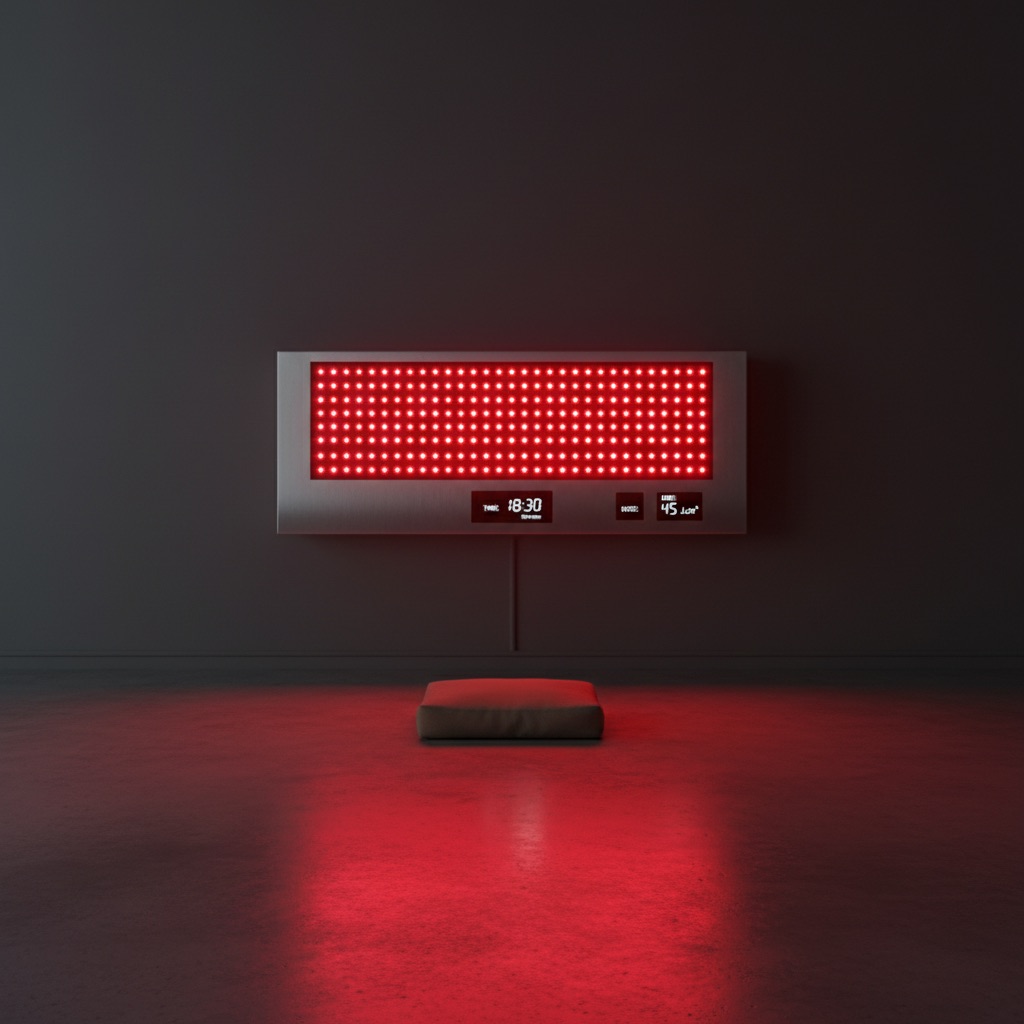
Most red light therapy panels come with vague instructions. “Use 10-20 minutes per area.” That is not wrong, but it skips everything that actually determines whether your sessions are effective: how far you stand from the panel, what dose your skin receives, and whether that dose matches your goal.
Dose is the single most important variable in red light therapy. Too little and nothing happens. Too much and you can actually inhibit the cellular processes you are trying to stimulate. This guide covers how dose works, what the research recommends for specific goals, and how to calculate the right protocol for your panel.
If you are new to red light therapy, start with our beginner’s guide for the science fundamentals. If you are choosing a panel, see our best red light therapy panels comparison.
What Is “Dose” and Why It Matters
In red light therapy, dose (also called fluence or energy density) is measured in Joules per square centimeter (J/cm2). It represents the total light energy delivered to a specific area of skin during one session.
The formula is straightforward:
Dose (J/cm2) = Irradiance (mW/cm2) x Time (seconds) / 1,000
- Irradiance is the intensity of light hitting your skin at a given moment, measured in milliwatts per square centimeter (mW/cm2). Your panel’s spec sheet should list this at a specific distance.
- Time is how long you stand in front of the panel, in seconds.
Example: Your panel delivers 100 mW/cm2 at 6 inches. You treat for 10 minutes (600 seconds). Dose = 100 x 600 / 1,000 = 60 J/cm2
That single number tells you more about whether your session will be effective than any other variable.
How Distance Changes Everything
Irradiance drops rapidly as you move away from your panel. Most manufacturers measure irradiance at 6 inches (15 cm), which is standard treatment distance for targeted work. But if you step back to 18-24 inches for full-body coverage, the light reaching your skin may be a quarter of the stated spec.
| Distance from panel | Typical irradiance | Best for |
|---|---|---|
| 6 inches (15 cm) | 80-150+ mW/cm2 | Deep tissue: joints, muscles, dense areas |
| 12 inches (30 cm) | 40-80 mW/cm2 | General use: skin health + moderate depth |
| 18-24 inches (45-60 cm) | 20-40 mW/cm2 | Surface skin: anti-aging, collagen, acne |
This is why “use for 10 minutes” is incomplete advice. Ten minutes at 6 inches delivers a very different dose than ten minutes at 24 inches.
Practical tip: If you moved from 6 to 12 inches, you roughly need to double your session time to deliver the same dose. Use your panel’s irradiance spec and the formula above to calculate your actual dose at your preferred distance.
The Biphasic Dose Response: More Is Not Better
This is the most important concept in red light therapy dosing, and the one most people get wrong.
Red light therapy follows a biphasic (two-phase) dose response, documented by Huang and Hamblin in their landmark 2009 paper. At low-to-moderate doses, cellular function improves: more ATP production, increased collagen synthesis, reduced inflammation. At higher doses, benefits plateau and then reverse. Very high doses can actually increase inflammation and inhibit the processes you are trying to stimulate.
Think of it like watering a plant. Too little and nothing grows. The right amount and it thrives. Too much and you drown the roots.
The practical implication: there is a therapeutic window for each condition. Staying within that window matters more than maximizing your session time.
Signs you may be overdosing:
- Persistent skin redness lasting more than 2 hours after treatment
- Increased pain or inflammation (symptoms getting worse)
- Unusual fatigue after sessions
- Dry, flaky skin in treated areas
- Headaches (especially with facial treatments)
If you notice any of these, reduce your session time or increase your distance from the panel.
Recommended Doses by Goal
The following dose ranges come from published clinical research. There is no single “perfect” dose for any condition, but these ranges represent the therapeutic windows where positive results have been consistently observed.
Skin Health and Anti-Aging
| Parameter | Recommendation |
|---|---|
| Target dose | 3-15 J/cm2 |
| Wavelengths | 630-660 nm (red) |
| Frequency | 2-3 sessions per week |
| Distance | 12-24 inches (surface targeting) |
| Duration for results | 8-12 weeks minimum |
A 2014 controlled trial by Wunsch and Matuschka used approximately 9 J/cm2 at 611-650 nm, twice weekly for 30 sessions. Results showed collagen density increase and wrinkle improvement in 69-75% of subjects. Key takeaway: moderate doses of red light, applied consistently over 2-3 months, produce measurable skin changes.
For anti-aging, red wavelengths (630-660 nm) are more effective than near-infrared because the target (fibroblasts in the dermis) sits relatively close to the skin surface.
Muscle Recovery and DOMS
| Parameter | Recommendation |
|---|---|
| Target dose | 10-30 J/cm2 per treatment area |
| Wavelengths | 630-660 nm + 810-850 nm (combined) |
| Timing | 3-5 minutes before exercise OR immediately after |
| Frequency | Daily around training sessions |
| Distance | 6-12 inches (deeper penetration needed) |
Research consistently shows that pre-exercise red light therapy reduces creatine kinase (a marker of muscle damage) and decreases DOMS severity. The combination of red and near-infrared wavelengths provides both surface and deep-tissue benefits. For lower body (quads, hamstrings, glutes), you need higher total energy because the muscle mass is larger.
Practical approach: Treat each muscle group for 3-5 minutes at 6-12 inches before training. Focus on the muscles you plan to work hardest.
Joint Pain and Arthritis
| Parameter | Recommendation |
|---|---|
| Target dose | 15-20 J/cm2 (for knee osteoarthritis) |
| Wavelengths | 810-850 nm (near-infrared preferred) |
| Frequency | 3-5 sessions per week |
| Distance | 6 inches (close targeting) |
| Duration for results | 6-8 weeks minimum |
A 2021 meta-analysis of 14 randomized controlled trials found that photobiomodulation significantly reduced pain scores and improved physical function in knee osteoarthritis. Near-infrared wavelengths (810-850 nm) are essential here because they penetrate deep enough to reach joint tissue. Red light (630-660 nm) alone does not reach large joints like knees, hips, or shoulders effectively.
For smaller joints (fingers, wrists), red wavelengths work well at close range.
Wound Healing
| Parameter | Recommendation |
|---|---|
| Target dose | 1-6 J/cm2 |
| Wavelengths | 630-660 nm + 830-850 nm |
| Frequency | Daily or every other day |
| Distance | 6-12 inches |
Wound healing uses the lowest effective doses among all applications. Studies on diabetic ulcers showed accelerated healing at just 2 J/cm2 using combined red and near-infrared light. Higher doses are not needed and may be counterproductive for wound tissue.
Hair Growth
| Parameter | Recommendation |
|---|---|
| Target dose | 10-67 J/cm2 |
| Wavelengths | 650-660 nm |
| Frequency | Every other day |
| Distance | 6-12 inches (scalp treatment) |
| Duration for results | 16 weeks minimum |
A double-blind randomized controlled trial by Lanzafame et al. (2014) used 67 J/cm2 at 655 nm, 25-minute sessions every other day for 16 weeks. The treatment group showed 37% greater hair growth than placebo. This is one of the most well-documented applications of red light therapy, but it requires patience: 16 weeks of consistent use before expecting visible results.
General Wellness
| Parameter | Recommendation |
|---|---|
| Target dose | 5-15 J/cm2 |
| Wavelengths | 630-660 nm + 810-850 nm (combination) |
| Frequency | 3-5 sessions per week |
| Distance | 12-18 inches |
| Session time | 10-20 minutes |
For general mitochondrial health and overall wellness, mid-range doses with a combination of red and near-infrared wavelengths cover the broadest range of benefits. Consistency over weeks and months matters more than any single session.
How to Calculate Your Session Time
Here is a quick reference for how long to treat based on your panel’s irradiance and your target dose:
| Your panel’s irradiance | Time for 5 J/cm2 | Time for 10 J/cm2 | Time for 20 J/cm2 |
|---|---|---|---|
| 25 mW/cm2 | 3 min 20 sec | 6 min 40 sec | 13 min 20 sec |
| 50 mW/cm2 | 1 min 40 sec | 3 min 20 sec | 6 min 40 sec |
| 100 mW/cm2 | 50 sec | 1 min 40 sec | 3 min 20 sec |
| 150 mW/cm2 | 33 sec | 1 min 7 sec | 2 min 13 sec |
To use this table: Find your panel’s irradiance at your treatment distance (check the manufacturer’s spec sheet). Then find the column matching your target dose for your goal. That gives you your session time per treatment area.
Starting Protocol for Beginners
If you are just getting started, use this 4-week ramp-up:
Weeks 1-2: Start at 50-75% of your calculated full dose. Treat 3 times per week. Stand at 12-18 inches. This lets your skin and cells adapt without overloading.
Weeks 3-4: Move to your full calculated dose. Maintain 3-4 sessions per week. Adjust distance based on your goal (closer for joints and muscles, farther for skin).
Week 5 onward: Fine-tune based on how your body responds. If you feel good and see results, maintain your protocol. If you notice any signs of overdosing, scale back.
Timing: Morning vs Evening
Morning sessions (preferred for most people): Red light therapy boosts ATP production and pairs well with your body’s natural cortisol peak in the morning. It does not suppress melatonin, making it a safe form of early-day light exposure. If your goal is energy and alertness, morning is ideal.
Evening sessions (60-120 minutes before bed): Good for muscle recovery after afternoon or evening training. Red wavelengths do not interfere with melatonin production the way blue or white light does. Can support a wind-down routine.
Avoid: Very bright sessions immediately before sleep. While the wavelengths are safe for circadian rhythm, the overall brightness of a high-output panel close to bedtime can be stimulating.
Eye Safety
- Red light (630-660 nm): Visible and bright. Closing your eyes is generally sufficient for moderate-intensity panels at standard distance.
- Near-infrared (810-850 nm): Invisible to the eye. You cannot see it, but it penetrates eyelids more easily than visible red light.
- Use eye protection when treating your face at close range (under 12 inches) with high-irradiance panels, especially those with strong near-infrared output.
- Never stare directly into the LEDs, regardless of wavelength.
- Consult a healthcare professional before use if you have cataracts, macular degeneration, or any retinal condition.
Bare Skin Required
Red and near-infrared light does not penetrate clothing effectively. Fabric blocks or significantly reduces the photons reaching your skin. Always treat bare, clean skin for the target area. Remove sunscreen, makeup, and lotions from treatment areas before sessions, as these can absorb or scatter light.
Six Common Dosing Mistakes
1. Standing too far away. At 3-4 feet from the panel, you may receive only a fraction of the labeled irradiance. Most effective treatments happen within 6-18 inches.
2. Sessions too long. More is not better. A 45-minute session at close range with a high-output panel can push well past 60 J/cm2, entering counterproductive territory for most goals. Calculate your dose and stay within the recommended range.
3. Inconsistent use. Sporadic sessions (once a week, skipping weeks) rarely produce measurable results. Most clinical studies showing positive outcomes used 3-5 sessions per week for 8-16 weeks. Consistency beats intensity.
4. Wrong wavelengths for the goal. Using only red (630-660 nm) for deep joint pain is insufficient, the light does not penetrate deep enough. Conversely, using only near-infrared for surface skin rejuvenation misses the sweet spot. Match your wavelengths to your target depth.
5. Not accounting for panel differences. A panel rated at 100 mW/cm2 at 6 inches requires very different treatment times than one rated at 30 mW/cm2 at the same distance. Always calculate based on your specific panel’s specs.
6. Treating through clothing or makeup. Fabric, sunscreen, and cosmetics block photons. Treat bare, clean skin.
Choosing a Panel for Flexible Dosing
For maximum dosing flexibility, choose a panel that offers both red (630-660 nm) and near-infrared (810-850 nm) wavelengths. This lets you address both surface and deep-tissue goals. Panels with independent channel control (run red only, NIR only, or both) give you the most protocol options.
Our panel comparison covers the top options. For a head-to-head look at two popular choices, see our Joovv vs Mito Red Light comparison. And if skin health is your primary focus, our red light therapy for skin guide covers wavelength and protocol specifics.
Key Takeaways
- Calculate your actual dose. Dose = irradiance x time. Do not rely on generic session recommendations.
- Stay within the therapeutic window. More is not better. The biphasic dose response means excessive dose can inhibit results.
- Match wavelengths to your goal. Red for skin and surface tissue. Near-infrared for joints, muscles, and deeper targets.
- Be consistent. 3-5 sessions per week for 8-12 weeks is where results happen.
- Start conservatively. Begin at 50-75% of your target dose and increase over 2-4 weeks.
Related Articles
Joovv vs Mito Red Light: Which Panel Is Actually Worth It?
A detailed spec-by-spec comparison of Joovv Solo 3.0 and Mito Red MitoPRO X. We break down wavelengths, irradiance, EMF, price, and who each panel is best for.
Red Light Therapy for Skin: What the Research Actually Says
A research-based look at red light therapy for skin health, from collagen and wrinkles to acne and wound healing. Real studies, practical protocols, and honest takeaways.
What Is Red Light Therapy? A Beginner's Guide
Everything you need to know about red light therapy: how it works, what the research says, and how to get started at home.