Theragun PRO Plus vs Hypervolt 3 Pro: Which Massage Gun Should You Buy?
A detailed spec-by-spec comparison of the Theragun PRO Plus and Hypervolt 3 Pro. We break down power, noise, features, price, and who each massage gun is best for.
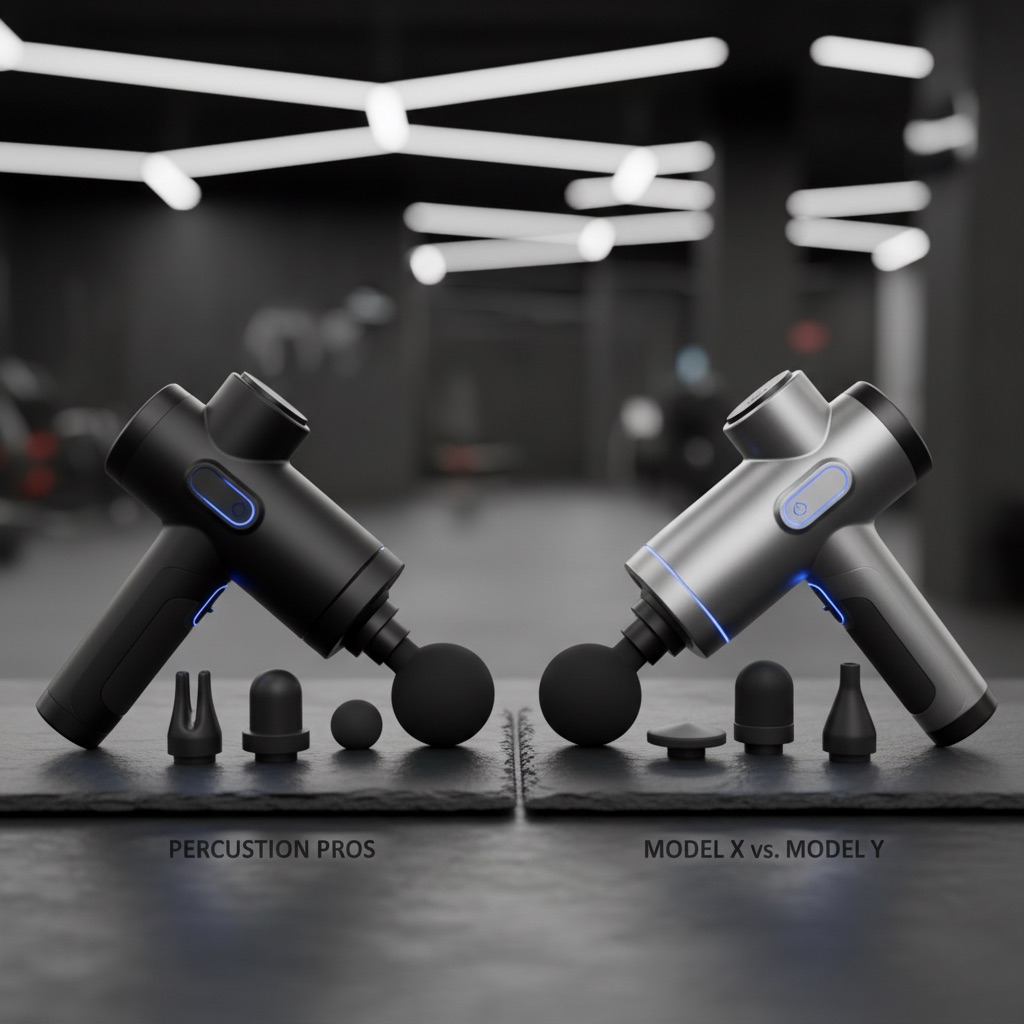
Winner: Hypervolt 3 Pro. Lighter, $300 cheaper, runs at 51 dB, and ships with a Heated Head attachment that adds warm-therapy without buying anything extra.
At a glance:
- Hypervolt 3 Pro (Hyperice, $349): best for most buyers, 51 dB QuietGlide motor, built-in pressure sensor, Heated Head attachment included
- Theragun PRO Plus (Therabody, $649): best for power users, deepest amplitude (16mm), 60 lb stall force, adjustable arm for solo back work
Theragun and Hypervolt are the two names that come up in every massage gun conversation. Therabody’s Theragun PRO Plus is the power-first flagship with the deepest amplitude on the market. Hyperice’s Hypervolt 3 Pro is the lighter, quieter alternative with a built-in pressure sensor and the new Heated Head attachment. The Nordic Recovery Guide team compared every specification that matters between the two to land on this recommendation.
For a broader look at all top massage guns, see our Best Massage Guns 2026 review. If you are new to percussion therapy, start with our beginner’s guide to massage guns.
The Full Verdict
For general recovery and everyday muscle soreness, the Hypervolt 3 Pro delivers everything most people need at a better price. The Theragun PRO Plus still hits deeper and has more stall force, plus the adjustable arm makes solo back work easier. But the price gap ($300) is hard to justify unless you specifically need maximum amplitude for dense tissue work.
Head-to-Head Specifications
| Feature | Hypervolt 3 Pro | Theragun PRO Plus |
|---|---|---|
| Price | $349 | $649 |
| Stall Force | ~35 lbs | 60 lbs |
| Amplitude | ~14 mm | 16 mm |
| Speed Settings | 6 (1500-2500 RPM) | 5 (customizable via app) |
| Battery Life | ~240 min | ~150 min (swappable) |
| Weight | 2.5 lbs / 1.13 kg | 3.6 lbs / 1.65 kg |
| Noise Level | ~51 dB (QuietGlide™) | ~42-53 dB |
| Attachments | 5 incl. Heated Head | 5 included |
| Bluetooth App | ||
| Pressure Sensor | ||
| Adjustable Arm | ||
| Warranty | 1 year | 1 year |
Amplitude and Power: Theragun’s Strongest Argument
This is where the Theragun PRO Plus has a genuine, measurable advantage.
Theragun PRO Plus delivers 16mm amplitude, the deepest stroke length of any mainstream massage gun. Combined with 60 lbs of stall force, it can dig into large muscle groups like glutes, quads, and upper back without the motor slowing down. If you are a larger athlete or need deep tissue work on dense muscle, this depth makes a real difference.
Hypervolt 3 Pro delivers approximately 14mm amplitude with roughly 35 lbs of stall force based on independent measurements. That is 2mm less depth and about 25 lbs less force before the motor stalls. For most people, 14mm reaches deep enough for effective recovery. The difference becomes noticeable mainly on larger muscle groups where you need to press firmly through thick tissue.
Our take: The Theragun hits harder and deeper. If you are over 200 lbs, have dense muscle mass, or work with clients professionally, the extra 2mm and 25 lbs of stall force are worth it. For everyone else, 14mm handles daily recovery well.
Noise: Hypervolt 3 Pro Closes the Gap
This is the spec that changed most between Hypervolt generations, and it matters more than people think for daily use.
Theragun PRO Plus uses QuietForce technology, running at approximately 42-53 dB across its speed range. Significantly quieter than older Theragun models.
Hypervolt 3 Pro uses Hyperice’s new QuietGlide™ technology and runs at around 51 dB. That is a meaningful drop from the previous Hypervolt 2 Pro (~55-66 dB) and brings the Hypervolt right next to the Theragun in real-world quietness.
Our take: The Theragun is still marginally quieter at lower speeds, but in everyday use the two are now hard to distinguish. The earlier generation’s noise gap was a real reason to consider the Theragun. With the Hypervolt 3 Pro, noise is no longer the differentiator it used to be.
Smart Features: Different Approaches
Both brands invest heavily in app ecosystems, but they solve different problems.
Hypervolt 3 Pro has two standout features: a built-in pressure sensor with LED indicators that show how hard you are pressing in real time, and the new Heated Head attachment that adds warm-therapy to your sessions without buying a separate accessory. The pressure feedback is more useful than it sounds. Most people either press too hard (causing bruising) or too lightly (reducing effectiveness). The Hyperice app adds guided routines with auto-adjusting speed and pressure targets.
Theragun PRO Plus offers more treatment modes. The Therabody app provides guided routines for specific body areas, pre-workout activation, and post-workout recovery. Two unique features set it apart:
- Recovery+ Mode: Combines pulsed percussion at 10Hz with continuous operation, designed for post-exercise recovery.
- Ambient Mode: A low-intensity vibration mode. Not percussive therapy, but a gentle vibration that some users find relaxing before sleep.
The Theragun’s app also connects via Bluetooth, allowing wireless control and multi-device linking if you own multiple Therabody products. A heated head attachment is sold separately.
Our take: The Hypervolt’s pressure sensor solves a real daily-use problem. You get actionable feedback every session. With the 3 Pro, you also get the Heated Head included in the box, which is a useful addition for stubborn knots. The Theragun’s extra modes (Recovery+, Ambient) are nice but more situational. If practical guidance and warm-therapy out of the box matter, the Hypervolt wins. If you want mode variety and a broader treatment ecosystem, the Theragun wins.
Ergonomics and Design
Theragun PRO Plus uses Therabody’s signature triangular handle with multiple grip positions. The adjustable arm lets you reach your back, shoulders, and spine area without contorting your wrist. For self-treatment of hard-to-reach areas, this is a meaningful design advantage. The trade-off is weight: at 3.6 lbs (1.65 kg), it is noticeably heavier, and extended sessions on your shoulders or neck can cause arm fatigue.
Hypervolt 3 Pro uses a traditional vertical handle. Comfortable for arms, legs, and chest, but reaching your own back requires more effort. At 2.5 lbs (1.13 kg), it is over a pound lighter than the Theragun. The overall design feels polished and the rubber grip is comfortable during long sessions. The 3 Pro also ships with a premium carry case.
Our take: The Theragun’s adjustable arm is a real advantage for solo back treatment. If you frequently work on your own back and shoulders without a partner’s help, the four-position arm is worth the extra weight. If you primarily use the massage gun on accessible areas (quads, calves, arms, chest), the Hypervolt’s lighter design is more comfortable for long sessions.
Battery: Hypervolt 3 Pro Pulls Ahead
Battery life is where the new generation pulled clearly ahead.
Hypervolt 3 Pro delivers approximately 240 minutes (4 hours) per charge, up from 180 minutes on the 2 Pro. The battery is sealed and non-removable, but at 4 hours per charge most home users go a full week between charges.
Theragun PRO Plus delivers approximately 150 minutes per charge with a swappable battery. You can buy extras and hot-swap during sessions. For therapists treating multiple clients per day, this is essential. For home users, the Hypervolt’s longer single-charge life is more convenient.
Our take: Hypervolt now leads on raw battery life by almost 1.5x. Swappable batteries still matter for professionals running back-to-back sessions, but for everyone else, 4 hours per charge means battery is not something you think about.
Warranty: Even Match
Both the Theragun PRO Plus and Hypervolt 3 Pro come with a 1-year warranty. Given the price premium of the Theragun, you might expect a longer warranty, but Therabody’s current terms are 1 year.
Our take: Even match on warranty. Neither brand stands out here.
Price: $300 Separates Them
| Hypervolt 3 Pro | Theragun PRO Plus | |
|---|---|---|
| Price | $349 | $649 |
| Price per mm amplitude | $24.93/mm | $40.56/mm |
The Hypervolt 3 Pro costs $300 less than the Theragun PRO Plus. For that $300 savings, you give up 2mm of amplitude, 25 lbs of stall force, the adjustable arm, the swappable battery, and slightly quieter operation at the low end. You gain a pressure sensor, a Heated Head attachment included, longer battery life, and a lighter device.
For most home users, $349 for the Hypervolt is the better value. The Theragun’s advantages (depth, power, arm, swappable battery) are real but most impactful for heavy daily use or professional settings.
Our take: The Hypervolt 3 Pro delivers solid therapeutic capability at roughly half the price, and the 3rd-gen updates (quieter motor, longer battery, Heated Head included) make it noticeably more polished than the 2 Pro. Unless you specifically need the extra depth, the adjustable arm, or the swappable battery, the savings are significant.
Who Should Buy the Theragun PRO Plus
The Theragun PRO Plus makes sense for specific use cases:
- You are a larger athlete. Over 200 lbs with dense muscle mass, the 16mm amplitude and 60 lbs stall force make a noticeable difference compared to 14mm/35 lbs.
- You treat hard-to-reach areas solo. The adjustable arm with four positions lets you reach your back and shoulders without assistance.
- You are a physical therapist or trainer. Swappable batteries, deeper strokes, and longer warranty suit daily professional use. Multiple Therabody devices can connect via Bluetooth.
- You want a multi-therapy device. Recovery+ mode and the heated attachment (sold separately) add treatment variety beyond percussion.
Who Should Buy the Hypervolt 3 Pro
For most buyers, the Hypervolt 3 Pro is the better fit:
- You want a lighter device. At 2.5 lbs vs 3.6 lbs, the Hypervolt is easier to maneuver during longer sessions and more comfortable to hold overhead.
- You want guided feedback. The pressure sensor shows you exactly how hard you are pressing, helping you get consistent, effective sessions every time.
- You want heat included. The new Heated Head attachment lets you combine warm-therapy with percussion without buying anything extra.
- You want longer battery life. 4 hours per charge means you charge it about once a week even with daily use.
- You want great performance at a lower price. ~14mm amplitude handles the vast majority of recovery needs. $349 is significantly more accessible than $649.
Our Verdict
The Hypervolt 3 Pro wins this comparison for most buyers. It is lighter, has a pressure sensor that improves every session, ships with a Heated Head attachment, runs almost as quietly as the Theragun at 51 dB, and costs $300 less. The ~14mm amplitude handles daily recovery effectively for the vast majority of people.
The Theragun PRO Plus is the right choice if you specifically need maximum depth and power, use the massage gun on hard-to-reach areas without help, or use it professionally with clients. The adjustable arm and swappable battery are designed for heavy, daily use.
Neither is a bad choice. Both are well-built percussion devices with solid app ecosystems. The question is whether the Theragun’s extra depth, power, and arm are worth $300 more for your specific needs. With the 3 Pro closing the noise gap and pulling ahead on battery, the case for the Hypervolt is stronger than ever.
If budget is a bigger factor, the Ekrin B37 at $188 covers the fundamentals with 56 lbs stall force and a lifetime warranty. And for a complete recovery approach, see how massage guns fit into a broader protocol in our recovery stacking guide.
Related Articles
What Are Massage Guns? A Beginner's Guide to Percussion Therapy
Learn how massage guns work, what they're good for, and how to use one effectively for muscle recovery.
Best Massage Guns 2026: Compared Head-to-Head
We compared the top percussion massage guns for recovery: Theragun PRO Plus, Hypervolt 3 Pro, and Ekrin B37. See which one fits your needs and budget.
Best Home Saunas 2026: Top Infrared Saunas Compared
We compare eight infrared saunas for home use, from a $2,099 budget cabin to full-spectrum and outdoor-rated models with built-in red light therapy.