Plunge All-In vs Ice Barrel 300: Chiller vs Manual Ice Compared
A detailed comparison of the Plunge All-In and Ice Barrel 300. We break down cooling, temperature control, maintenance, total cost, and who each cold plunge is best for.
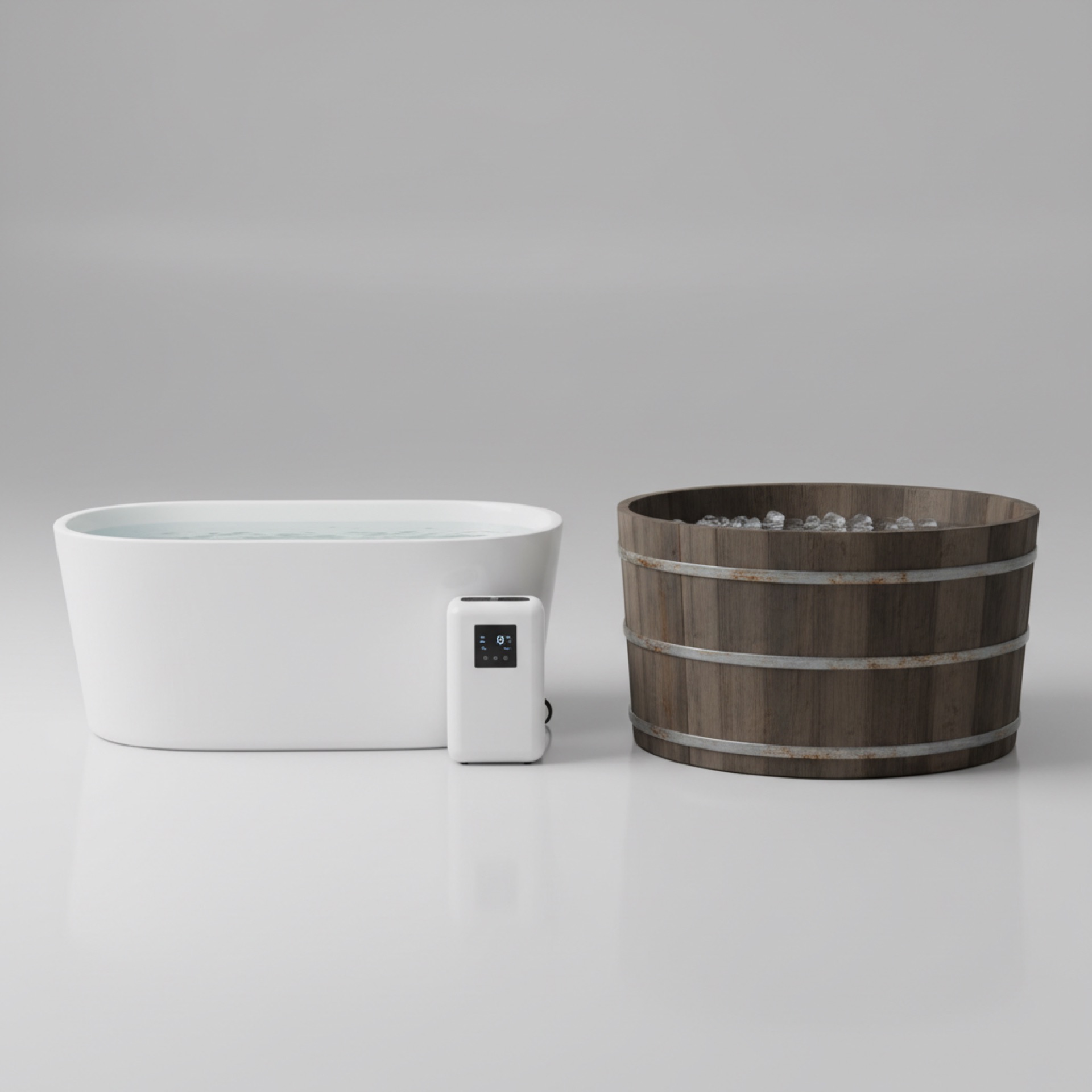
Winner: Plunge All-In if convenience matters; Ice Barrel 300 if you want the cheapest legitimate path in. The Plunge holds 39°F automatically with ozone filtration; the Ice Barrel costs a quarter as much but you have to bag ice every session.
At a glance:
- Plunge All-In (Plunge, $7,990): integrated chiller plus ozone filtration, set-and-forget temperature, plug-and-plunge with no plumbing
- Ice Barrel 300 (Ice Barrel, $1,150): upright insulated barrel, no chiller, daily ice fill required
The Plunge All-In and the Ice Barrel 300 represent two fundamentally different approaches to cold water immersion. The Plunge is a premium chiller-equipped tub that maintains your set temperature automatically. The Ice Barrel is a simple, insulated barrel that relies on bags of ice. One costs many times more than the other.
If you are choosing between these two, the decision comes down to how much daily friction you are willing to accept, and how much that convenience is worth to you. This comparison covers every practical difference to help you decide.
For a broader look at cold plunge options, see our Best Cold Plunge Tubs 2026 review. If you are new to cold water immersion, start with our beginner’s guide to cold plunge therapy.
The Quick Answer
The Plunge All-In is the better long-term investment for daily users who want zero preparation before each session. Set your temperature, lift the cover, step in. The Ice Barrel 300 is the smarter entry point for people who want to explore cold plunging without committing thousands of dollars, or who value simplicity and portability over automation.
Head-to-Head Specifications
| Feature | Plunge All-In | Ice Barrel 300 |
|---|---|---|
| Type | Chiller-equipped tub | Insulated barrel |
| Cooling method | Built-in chiller | Manual ice |
| Temperature range | 37-60°F (3-16°C) | Depends on ice amount |
| Temperature control | WiFi app, precise | Approximate |
| Capacity | 125 gallons (~475 liters) | 105 gallons (~400 liters) |
| Fits height up to | 6'5" (196 cm) | 6'2" (188 cm) |
| Insulation | Full insulation + cover | Double-wall |
| Filtration | Ozone + filter | Manual water changes |
| Requires electricity | ||
| Position | Reclined/seated | Upright/seated |
| Warranty | 2 years | Limited lifetime |
| Price | $7,990 | ~$1,150 |
Cooling: The Core Difference
This is the single biggest factor in the comparison and the reason for the price gap.
Plunge All-In has a built-in chiller that cools water down to 37°F (3°C) and holds it there indefinitely. You set your target temperature through the WiFi app, and the chiller maintains it around the clock. When you want to plunge, you lift the insulated cover and step in. No preparation, no waiting, no ice runs.
Ice Barrel 300 uses manual ice. You add 40-60 lbs of ice before each session, wait 10-15 minutes for the water to cool, and then get in. In cold climates during winter, ambient temperatures do much of the work. In summer, you rely entirely on ice. Budget $5-15 per session for store-bought ice.
Our take: If you plan to cold plunge daily, the chiller removes the friction that causes many people to quit after a few weeks. Research on habit formation consistently shows that reducing barriers increases adherence. The Ice Barrel requires a deliberate effort each time, which can be a positive ritual for some, but a dropout risk for others.
Temperature Control: Precision vs Estimation
Plunge All-In lets you dial in an exact temperature through the app. Want 45°F today and 50°F tomorrow? Adjust it from your phone. The water is at your target temperature when you arrive. This precision is useful if you follow a progressive cold exposure protocol where you gradually lower the temperature over weeks.
Ice Barrel 300 gives you approximate control. More ice means colder water, but you are estimating rather than setting a number. A floating thermometer helps, but there is no way to maintain a specific temperature over time. The water gradually warms as the ice melts.
Our take: For most people, approximate temperatures work fine. Cold is cold. But if you are following a structured protocol or tracking your exposure data, the Plunge’s precision is a genuine advantage.
Size, Comfort, and Fit
Plunge All-In comfortably fits most adults in a seated position, deep enough to submerge up to your neck. It uses a more compact footprint than older XL-sized tubs while still leaving room to settle in.
Ice Barrel 300 fits users up to about 6’2” in an upright seated position. You sit with your knees slightly bent and water reaches your chest. The barrel design uses less water than a full tub, which means less ice to cool it. Taller users may find it snug.
Our take: The Plunge is more comfortable for larger users and longer sessions. The Ice Barrel’s compact design is an advantage if space is limited, since it takes up roughly the footprint of a large trash can.
Water Quality and Maintenance
This is where the daily experience diverges significantly.
Plunge All-In includes ozone sanitation and a filter system. Water stays clean for months without draining. You add a small amount of sanitizer periodically and change the filter as needed. The maintenance is minimal and similar to a hot tub.
Ice Barrel 300 has no filtration system. You change the water every 1-2 weeks depending on usage, or more often in warm weather. Some users add a small amount of hydrogen peroxide between water changes. Without a sanitation system, bacterial growth is a real consideration, especially in summer.
Our take: The Plunge wins clearly on maintenance. If the idea of draining and refilling a barrel every week sounds tedious, the chiller system’s built-in sanitation is worth the premium.
Total Cost of Ownership
The sticker prices tell part of the story. The ongoing costs tell the rest.
Plunge All-In costs ~$7,990 upfront. Ongoing costs are electricity (roughly $30-50/month depending on climate and set temperature) plus occasional filter replacements and sanitizer. The second-generation chiller cools faster and uses about half the energy of older units. Over two years, the total cost is approximately $8,800-9,400.
Ice Barrel 300 costs ~$1,150 upfront. If you buy ice at $5-15 per session and plunge 4-5 times per week, that is $80-300 per month. Over two years at a moderate pace, the total cost is approximately $3,100-8,400, depending heavily on ice consumption.
Our take: The Ice Barrel has a dramatically lower entry point. But frequent ice buyers still spend well below the Plunge over two years, though heavy ice use narrows the gap. If you make your own ice with a chest freezer ($150-300), the economics shift back in the Ice Barrel’s favor.
Portability and Setup
Plunge All-In is heavy once filled and stays put once placed. You need access to an outdoor GFCI outlet or an indoor setup with adequate drainage. The chiller unit needs ventilation. This is a semi-permanent installation.
Ice Barrel 300 weighs about 55 lbs empty. You can move it between a patio, garage, and backyard without much effort. No electricity, no plumbing, no permanent setup. Fill it with a garden hose and start using it.
Our take: If you rent your home, move frequently, or want to bring your cold plunge to a cabin, the Ice Barrel’s portability is a major advantage. The Plunge is for permanent setups where you have space and power.
Who Should Buy the Plunge All-In
- You want cold plunging as a daily habit with zero preparation
- You value precise temperature control and app-based scheduling
- You prefer minimal maintenance (months between water changes)
- You have space for a permanent outdoor or indoor installation
- Budget is secondary to consistency and convenience
Who Should Buy the Ice Barrel 300
- You want to try cold plunging without a large financial commitment
- You prefer a simple, no-electricity setup
- Portability matters (renters, small spaces, seasonal use)
- You enjoy the ritual of preparing your own ice bath
- You live in a cold climate where winter temperatures do the work
Our Verdict
The Plunge All-In is the better product for committed daily users. The chiller, filtration, and app control remove every practical barrier. The cost is significant, but the convenience is real, and convenience determines whether most people stick with cold plunging long-term.
The Ice Barrel 300 is the better starting point. At $1,150, it lets you build a cold plunge habit without the financial pressure of a $7,990 investment. The hands-on approach works well, especially in colder climates where nature provides the cooling.
Both are solid choices. The question is whether you want automation or simplicity. For more options, see our full cold plunge comparison. To build your first cold plunge routine, our 4-week beginner protocol walks you through it step by step. And for the complete recovery stack, pair your cold plunge with an infrared sauna using our contrast therapy protocol.
Related Articles
Cold Plunge Routine for Beginners: Your First 4 Weeks
A week-by-week cold plunge protocol for beginners. Covers temperature, duration, breathing, timing, and how to build a sustainable routine based on research.
What Is Cold Plunge Therapy? A Beginner's Guide
Everything you need to know about cold water immersion: the benefits, the risks, and how to start safely.
Best Cold Plunge Tubs 2026: Compared Head-to-Head
We compare the best cold plunge tubs for home use, from premium chillers to budget ice baths. Find the right cold plunge for your routine.