Red Light Therapy vs Infrared Sauna: Which One Should You Buy First?
A practical comparison of red light therapy panels and infrared saunas. We use the Joovv Solo 3.0 and Sun Home Luminar 2 as reference points and break down mechanism, benefits, cost, and who each tool fits best.
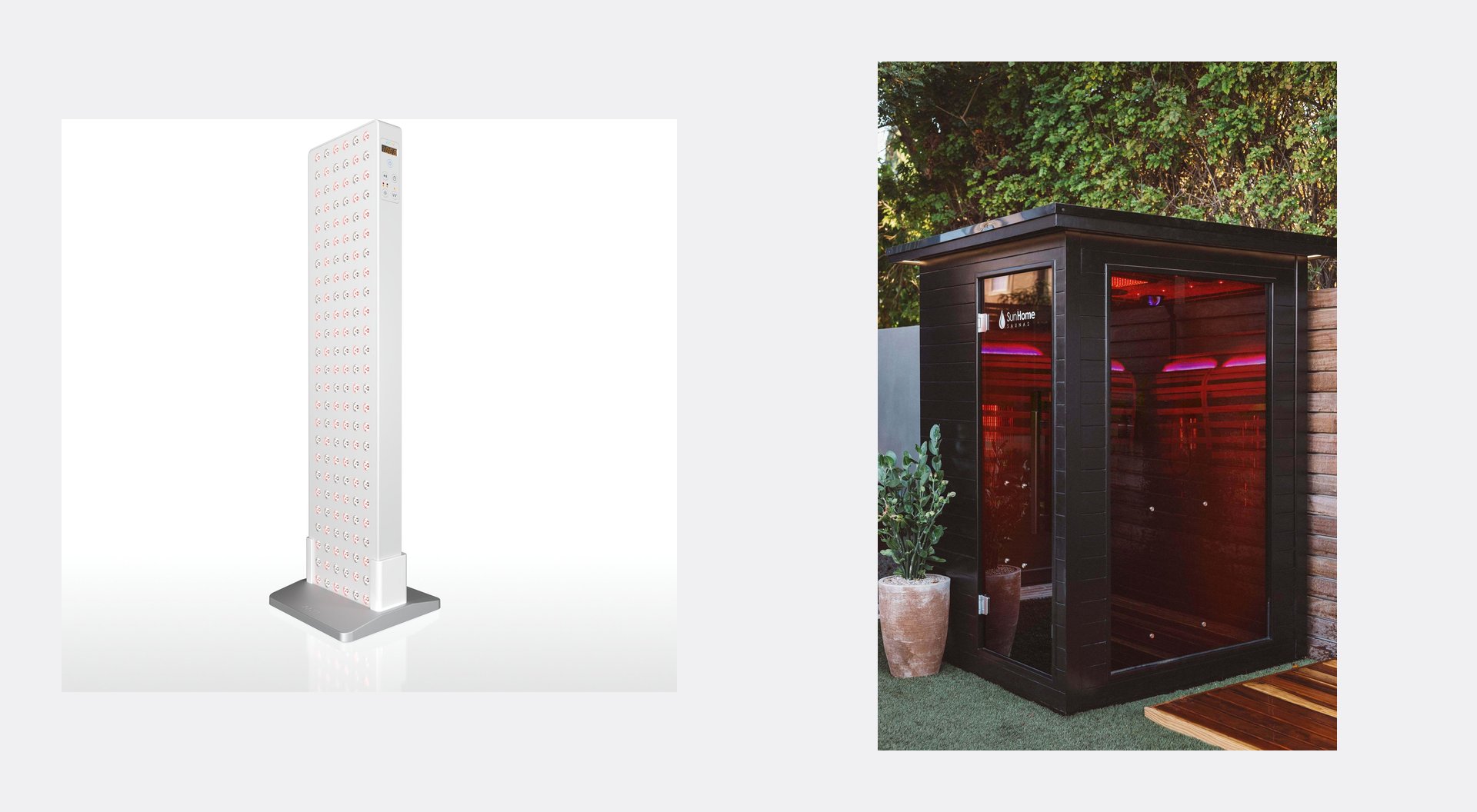
Red light therapy panels and infrared saunas both deliver light in the red and near-infrared spectrum. From there, they diverge sharply. A panel concentrates specific wavelengths at high irradiance directly onto your skin to drive cellular changes. A sauna uses a broader infrared band to heat your body until you sweat, triggering a stress response your cardiovascular system adapts to.
The Joovv Solo 3.0 sits at $1,699 and treats one body area at a time in 10-minute sessions. The Sun Home Luminar 2 sits at $10,999 and delivers a 30-minute full-body heat session for one or two people. Both have research behind them. Neither replaces the other.
For a broader view of every panel we recommend, see our Best Red Light Therapy Panels 2026 review. For saunas, see Best Infrared Saunas 2026. New to either? Start with our red light therapy guide or infrared sauna guide.
The Quick Answer
If you want to target a specific issue (skin, a sore joint, an injury, an inflamed area), pick red light therapy. The Joovv Solo 3.0 or any quality panel delivers concentrated 660nm and 850nm light at the wavelength range and irradiance the research uses.
If you want whole-body recovery, cardiovascular adaptation, and a hard sweat, pick an infrared sauna. The Sun Home Luminar 2 (or another cabin) drives heat-shock proteins, lowers resting heart rate over weeks of use, and gives you the ritual of a Nordic sauna.
If your budget allows both, start with the sauna if you’re after general recovery and stress reduction, start with the panel if you have a specific skin or joint goal. Most committed users end up owning both, used at different times of day for different reasons.
Head-to-Head Specifications
| Feature | Joovv Solo 3.0 | Sun Home Luminar 2 |
|---|---|---|
| Mechanism | Photobiomodulation | Heat-shock response (thermal stress) |
| Wavelengths | 660nm + 850nm | Full-spectrum infrared (far + mid + near) |
| Irradiance | ~59-74 mW/cm² (third-party measured) | Diffuse, ambient heating |
| Session length | 10-20 minutes | 30-45 minutes |
| Coverage per session | One body area | Whole body, 1-2 people |
| Heat-up time | Instant | 30-45 minutes |
| Setup | Wall mount or stand | Assembly + electrical install |
| Installation cost | $0 | $1,100-$1,300 |
| Footprint | 36 x 8 x 3 inches | 47 x 41 x 75 inches |
| Price | $1,699 | $10,999 |
Different Mechanisms, Different Outcomes
This is the crux of the comparison and the one most articles skip.
Red light therapy works through photobiomodulation. Specific red (660nm) and near-infrared (850nm) wavelengths are absorbed by cytochrome c oxidase, an enzyme in the mitochondria. That absorption boosts ATP production and triggers downstream effects: more collagen synthesis, reduced inflammatory signaling, faster wound healing, and improved cellular energy. The dose is delivered through concentrated light at high irradiance. The body part you point the panel at is the body part that benefits.
Infrared saunas work through heat. The infrared wavelengths penetrate the skin and warm the body from within rather than heating ambient air the way a traditional sauna does. The primary mechanism is the cardiovascular and metabolic adaptation that comes from repeated thermal stress: lower resting heart rate, improved endothelial function, heat-shock protein expression, and the well-documented sweat response. Some near-infrared exposure happens incidentally inside a full-spectrum cabin, but the irradiance is far lower than what a dedicated panel delivers.
In short: a panel changes cells through light. A sauna changes cardiovascular function through heat. Both improve recovery, but through different doors.
Cost: A 7x Gap Before Installation
The Joovv Solo 3.0 lands at $1,699 with no installation cost. Plug it into a standard outlet and mount it on a wall or stand. You can find capable panels for less. The MitoPRO 1000+ we cover in our best panels review delivers four wavelengths for $869. Budget-friendly entry points like the NovaaLab Pad start around $350.
The Sun Home Luminar 2 is $10,999 from the manufacturer plus roughly $1,100 to $1,300 for an electrician to install the 240V/20A dedicated circuit it requires. Total cost lands above $12,000. Indoor cabins from Sunlighten or Sun Home start lower (around $5,600 to $7,000), and a sauna blanket like the HigherDOSE delivers most of the sweat for $699.
Even at entry-level prices on both sides, a sauna setup typically costs three to four times what a quality panel does. If budget is the deciding factor, the panel gets you started faster.
Time per Session
A red light therapy session is short. Most protocols call for 10 to 20 minutes per body area, with the panel placed 6 to 12 inches from the skin. You can do a session before bed, during a podcast, or while answering email at a standing desk. No setup, no cool-down.
An infrared sauna session takes longer because the cabin itself takes 30 to 45 minutes to heat up before you climb in. Once you’re in, a typical session runs 20 to 45 minutes depending on heat tolerance. Add a shower afterward and you’ve spent over an hour on the practice. This is not a downside if you treat the sauna as your wind-down ritual. It is a downside if you’re trying to fit recovery into a packed weekday.
What the Research Actually Supports
The clinical evidence for both is strong but covers different ground.
Red light therapy has thousands of peer-reviewed studies on photobiomodulation. The strongest evidence is for skin conditions (acne, psoriasis, wound healing, fine lines), joint pain, hair regrowth (androgenetic alopecia), and muscle recovery. The dose-response curve is well established: too little does nothing, too much overshoots the biphasic window. Dosing matters more than people realize. See our red light therapy dosing guide for the numbers.
Infrared sauna evidence sits on top of the broader sauna research, which is dominated by Finnish cohort studies showing that frequent sauna users have lower all-cause mortality, lower cardiovascular event rates, and lower dementia risk. Most of that data is from traditional Finnish saunas, not infrared specifically, but the cardiovascular adaptation mechanism overlaps. Direct infrared sauna studies show meaningful improvements in cardiovascular function, blood pressure, and chronic pain symptoms. Detox claims are largely unsupported by quality evidence.
If your goal maps to skin, joints, or local tissue, RLT has the more direct evidence. If your goal is cardiovascular health, stress reduction, or general recovery, sauna research is broader and longer-running.
Space and Setup
A panel needs about as much wall space as a small mirror. It mounts on a stud, hangs from a stand, or leans against a wall. You can move it between rooms. You can take it apart and put it in a closet when guests come over.
A cabin sauna is permanent. You decide where it goes, you have an electrician install the circuit, and that’s where it lives. Outdoor cabins like the Luminar 2 need a level deck or slab and a covered or weather-rated location. Indoor cabins need a room with adequate ventilation and floor clearance. Sauna blankets sidestep the space issue but trade off the experience.
If you live in an apartment, rent, or move every few years, a panel works and a cabin does not. A blanket is the middle path.
Stacking: They’re Complementary, Not Competitive
Many people who own both treat them as different tools for different times. A morning panel session on the face for skin, an evening sauna session for cardiovascular load and sleep. Some users do a 10-minute panel session inside the sauna, which is fine but doesn’t double the benefits. The irradiance from a panel held 30 inches away through cabin air is much lower than at standard 6-inch treatment distance.
The honest framing: if you can afford both, they cover different ground and the combination is more powerful than either alone. If you can only afford one, the choice depends on what you’re actually trying to fix.
Who Should Buy a Red Light Therapy Panel First
The panel makes sense if:
- You have a specific issue. Skin condition, joint pain, hair thinning, a recurring injury, post-workout muscle soreness in a specific area. RLT targets these directly.
- You’re space-constrained. A panel fits in any room.
- You want a short, daily practice. 10-minute sessions are easier to make habitual than 45-minute sauna sessions.
- Budget is under $2,000. Entry-level panels start around $350. You can build a real practice without spending sauna money.
- You want the cellular-level intervention. Panels deliver concentrated wavelength at known irradiance. The mechanism is direct.
Who Should Buy an Infrared Sauna First
The sauna makes sense if:
- Your goal is cardiovascular or stress-related. Heat-shock response, lower resting heart rate, improved blood pressure, sleep quality, and stress reduction are sauna territory.
- You want a ritual, not just a treatment. Saunas are an experience. Panels are a tool.
- You have the space and budget. Owning your home and having $5,000+ to invest changes the equation.
- You’ll use it 3+ times a week. Daily users get the most out of the investment. Once-a-week users would be better served by paying for a sauna membership.
- You want to share it. Two-person cabins turn the practice into something you can do with a partner.
- You can’t easily access a public sauna. If your city or gym already has a sauna you’ll actually use, the home cabin math gets harder to justify.
Our Verdict
This is not a winner-takes-all comparison. Red light therapy and infrared sauna solve different problems through different mechanisms.
If you have a specific issue you want to address (skin, joints, recovery in a localized area) or you’re working within a budget under $2,000, start with a quality red light therapy panel. The Joovv Solo 3.0 is the polished premium option. The MitoPRO+ series is the better value pick, with the mid-size 1000+ at $869. Either gets you started with a tool the research supports.
If you’re after whole-body cardiovascular adaptation, stress reduction, and the ritual of a Nordic sauna practice (and you have the space and budget), the sauna delivers something a panel cannot. The Sun Home Luminar 2 is the premium outdoor option. A sauna blanket like the HigherDOSE at $699 is the realistic entry point if a full cabin is not in the cards.
For most people new to recovery tools, the better question is not which one but in what order. Start with the one that fits your space, budget, and primary goal. Add the other when the first becomes a habit.
For broader stacking strategy across multiple recovery tools, see our recovery stacking guide. For contrast therapy combining sauna with cold plunge, see our contrast therapy protocol.
Related Articles

Best LED Face Masks 2026: 5 Red Light Masks Compared
We compared the best LED face masks of 2026 on LED count, wavelengths, FDA clearance, and price. Here are five red light masks actually worth considering.
Joovv vs Mito Red Light: Which Panel Is Actually Worth It?
A detailed spec-by-spec comparison of Joovv Solo 3.0 and Mito Red MitoPRO+. We break down wavelengths, irradiance, EMF, price, and who each panel is best for.
Red Light Therapy Dosing Guide: How Long, How Close, How Often
A practical guide to red light therapy dosing. Covers how to calculate your dose, recommended protocols by goal, session timing, and the most common mistakes that reduce results.